Free Timothys Vision of Jesus Standing to Welcome Him Home Clip Art
Jesus' interactions with women are an important element in the theological debate nearly Christianity and women. Women are prominent in the story of Christ Jesus. He was born of a adult female, had numerous interactions with women, and was seen outset by women later his resurrection. He deputed the women to go and tell his disciples that he is risen, which is the essential message of Christianity.
High number of references to women [edit]
According to New Testament scholar Frank Stagg and classicist Evelyn Stagg,[1] the synoptic Gospels of the canonical New Testament contain a relatively high number of references to women. Evangelical Bible scholar Gilbert Bilezikian agrees, peculiarly by comparison with literary works of the same epoch.[2] : p.82 Neither the Staggs nor Bilezikian find whatever recorded instance where Jesus disgraces, belittles, reproaches, or stereotypes a woman. These writers claim that examples of the fashion of Jesus are instructive for inferring his attitudes toward women and prove repeatedly how he liberated and affirmed women.[1] Starr writes that of all founders of religions and religious sects, Jesus stands alone equally the one who did not discriminate in some way against women. By word or human activity he never encouraged the disparagement of a adult female.[3] Karen King concludes, based on the account of Jesus' interaction with a Syrophoenician woman in Mark 7:24-30 and Matthew 15:21-28, that "an unnamed Gentile woman taught Jesus that the ministry building of God is non limited to particular groups and persons, but belongs to all who have organized religion."[4]
Women as disciples [edit]
The gospels of the New Testament, written toward the last quarter of the get-go century AD, often mention Jesus speaking to women publicly and openly confronting the social norms of the time.[5] From the beginning, Jewish women disciples, including Mary Magdalene, Joanna, and Susanna, had accompanied Jesus during his ministry and supported him out of their private ways.[Lk. 8:1-three] [6] Kenneth Due east. Bailey[7] spent 40 years equally a Presbyterian professor of New Testament in Egypt, Lebanon, Jerusalem and Cyprus. He writes well-nigh Christianity from a Middle Eastern cultural view. He finds testify in several New Testament passages that Jesus had women disciples. He starting time cites the reported occasion when Jesus' family appeared and asked to speak with him. Jesus replied:
"Who is my female parent, and who are my brothers?" And stretching out his mitt towards his disciples, he said, "Here are my mother and my brothers! For whoever does the will of my Male parent in heaven is my brother, and sister, and mother."
Bailey argues that co-ordinate to Centre Eastern customs, Jesus could not properly accept gestured to a crowd of men and said, "Here are my brother, and sister, and mother." He could only have said that to a crowd of both men and women. Therefore, the disciples standing before him were composed of men and women.[7]
Women of obscurity noticed past Jesus [edit]
The Gospels record several instances where Jesus reaches out to "unnoticeable" women, inconspicuous silent sufferers who alloy into the groundwork and are seen by others every bit "negligible entities destined to exist on the fringes of life."[2] Jesus notices them, recognizes their need and, "in 1 gloriously wrenching moment, He thrusts them on center stage in the drama of redemption with the spotlights of eternity beaming down upon them, and He immortalizes them in sacred history."[2] : p.82
Peter's mother-in-law [edit]
- Matthew 8:14-fifteen, Mark 1:30-31, Luke four:38-39
The three synoptic gospels all record the healing of Simon Peter'southward mother in law. When Jesus came into Peter's house, he saw Peter's mother-in-law lying in bed with a fever. He healed the adult female of fever by touching her manus. She rose and began to wait on him. With this detail healing, something unique occurs. Quite often, afterwards existence healed, people left Jesus to go nearly their renewed lives. Peter's mother-in-law, however, immediately rose and began to "serve" him.
The adult female who touched Jesus' garment [edit]

Illustration by Paolo Veronese of Jesus healing the woman with a flow of blood.
- Marker 5:25-34
Jesus proficient the ministry of touch, sometimes touching the "untouchables" and letting them affect him. Amongst the things considered defiling (disqualifying one for the rituals of faith) was an issue of blood, especially menstruation or hemorrhage. 1 such woman had been plagued with a flow of claret for 12 years, no one having been able to heal her. She found the organized religion in a oversupply to force her fashion up to Jesus, approaching him from behind and so as to remain inconspicuous, and simply touching his garment.[Mk. 5:27] When she did, ii things happened: the flows of blood stopped and she was discovered.[2] : p.83
Jesus turned and asked who touched him. The disciples tried to brush aside the question, protesting that in such a oversupply no individual could exist singled out. Jesus pressed his inquiry and the woman came and trembled at his feet; she explained her reason and declared amid the crowd what approval had come to her.[Lk. 8:47] Jesus treated her as having worth, not rebuking her for what the Levitical code of holiness would have considered as defiling him.[Lev. fifteen:19-25] Rather, he relieved her of whatever sense of guilt for her seemingly rash act, lifted her upward and called her "Daughter." He told her that her religion saved her, gave her his love, and sent her abroad whole.[Mk. 5:34]
Fontaine writes, "The 'chutzpah' shown past the adult female who bled for 12 years as she wrests her salvation from the healer'southward cloak is as much a mensurate of her desperation as information technology is a testimony to her faith."[8] : p.291 Fontaine comments that "the Bible views women as a grouping of people who are fulfilled, legitimated, given total membership into their community, and cared for in old age by their children," and that barren women risked ostracism from their communities. She notes that when disabled people are healed, the deed "emphasizes primarily the remarkable compassion of the one doing the good deed, not the deserving nature or dignity of the recipient."[8] : p.290
Daughter of Jairus [edit]
- Marker 5:35-43
Jairus was one of the rulers of the Jewish synagogue, and had a daughter who had been very ill and was now at the point of decease. She was an only daughter, and was twelve years of age. So hearing that Jesus was nearly, Jairus came to Jesus, and, falling down before him, implored Jesus to come up and encounter his ill daughter. She had been comatose, and in Matthew 9:xviii her begetter says she is already expressionless. Jesus went to her, even though the others mocked him and said it was too late. When he saw her torso, he took her by the hand and said to her, "Talitha koum," which means, "Little girl, I say to you, arise!" She immediately arose and walked around. He gave strict orders that no one should know this and said that she should exist given something to eat.
Widow of Nain [edit]
- Luke 7:11-17
The widow lived in a remote small town on a hillside in Galilee. However, the death of her only son left her with petty means of support.[i Tim. 5:4] Jesus noticed the grieving woman in the funeral procession. Jesus gave the command "Arise!" and gave the bewildered son dorsum to his mother. "They all knew that God had a special beloved for the little widow with one son in Nain of Galilee."[2] : p.84
The adult female aptitude double [edit]
- Luke 13:ten-17
Jesus was teaching in a synagogue on the Sabbath and saw a woman who had been "crippled by a spirit for eighteen years". She was aptitude over and could not straighten upwards at all. He called to the woman, said "Adult female, y'all are prepare free from your infirmity", then laid his hands on her body, and immediately she straightened up and praised God.[Lk. xiii:13]
The synagogue ruler, the defender of the Sabbath, was indignant because Jesus had healed on the Sabbath. Rather than confront Jesus, he rebuked the woman publicly by maxim to the whole congregation, "There are six days for work. So come up and be healed on those days, not on the Sabbath".[9] In response, Jesus said, "You hypocrites! Doesn't each of you on the Sabbath untie his ox or donkey from the stall and atomic number 82 it out to give it h2o? So should not this adult female, a daughter of Abraham, whom Satan has kept spring for eighteen long years, be set free on the Sabbath 24-hour interval from what bound her?"[Lk. 13:xv-xvi] The Staggs emphasize that this is the only reference in New Testament to "a daughter of Abraham".[1] They conclude that Jesus spoke of this woman every bit though she belonged to the family of Abraham just equally much as did the sons of Abraham.
Women as models of religion [edit]
Jesus who always kept his covenant of chastity presented women as models of faith to his listeners. In the culture of the day, women were neither to be seen nor heard since they were considered "corrupting influences to be shunned and disdained."[ii]
The widow of Zarephath [edit]
- Luke 4:24-26
The Queen of the S [edit]
- Luke eleven:31
Parable of the x virgins [edit]
- Matthew 25:1-13
The persistent widow [edit]
- Luke 18:i-eight
A poor widow's offering [edit]
- Marker 12:41-44, Luke 21:1-4
Jesus honors a poor widow who cast "two copper coins" into the Temple treasury. What the widow gave to God was the totality of her holding. Women had only limited access to the Temple in Jerusalem. There Jesus plant the most praiseworthy piety and sacrificial giving, non in the rich contributors, but in a poor adult female.[1]
Women as models of Jesus' work [edit]
In the Parable of the Lost Money and the Parable of the Leaven, Jesus presents his ain work and the growth of the Kingdom of God in terms of a woman and her domestic piece of work.[10] These parables follow the Parable of the Lost Sheep and the Parable of the Mustard Seed respectively, and share the aforementioned messages as their more male person-oriented counterparts.
Joel B. Light-green writes of the Parable of the Leaven that Jesus "asks people — male person or female person, privileged or peasant, it does non affair — to enter the domain of a first-century adult female and household cook in order to proceeds perspective on the domain of God."[xi]
Women every bit persons of value [edit]
Raising their expressionless [edit]
The Gospels describe three miracles of Jesus raising persons from the dead. In two out of those three incidents the expressionless are restored to women--to Mary and Martha their brother Lazarus[Jn. 11:one-44] and to the unnamed widow from Nain her just son.[Lk. 7:11-17]
Alarm against animalism [edit]
- Matthew 5:27-29
In the Sermon on the Mount, Jesus expounded upon the Ten Commandments. He defended the value of women and men by equating lust to infidelity, punishable by hell.
Warning confronting divorce [edit]
- Matthew 5:31-33
Jesus expounded upon the Book of Deuteronomy. Regarding men's custom of divorce, he defended the rights of wives by equating unjustified divorce with the guilt of causing the sin of adultery.
Women as first resurrection witnesses [edit]
Later on the Resurrection of Jesus, he chose to announced first to a grouping of women and gave them the privilege of proclaiming his resurrection and communicating his instructions to the Apostles.[Mt. 28:eight-10]. In the story, appearing commencement to them implies his claim was not dishonest because a rational deceiver would non appear to witnesses that could non show in court (i.due east., the grouping of women).
Mary, female parent of Jesus [edit]
At the Temple in Jerusalem [edit]
- Luke 2:41–52
The canonical Gospels offer but 1 story about Jesus as a male child—Luke's story nigh the boy Jesus in the Jerusalem Temple. According to Luke, his parents, Joseph and Mary, took the 12-year-sometime Jesus to Jerusalem on their almanac pilgrimage to the Passover. Mary and Joseph started their journey home without Jesus, thinking he was somewhere in the caravan with kinsmen or acquaintances. When his parents found him three days later, Mary said, "Son, why have you treated united states of america like this? Your begetter and I have been anxiously searching for you." The boy Jesus respectfully but firmly reminded her of a higher claim he must answer: "Didn't you lot know I had to be virtually my Father's business?"[1] : pp.103–104, 224 It is noteworthy that in obedience to his parents, Jesus left and was subject field to them.
At the wedding ceremony in Cana of Galilee [edit]
- John 2:1–11
Mary told Jesus the wine was in curt supply. Today his reply may seem curt: "Woman, what accept I to exercise with you? My 60 minutes is not yet come up."[Jn. ii:four]
Neither hither nor elsewhere does Jesus renounce the mother-son relationship as such, but here, equally in Luke 2:49, he declares his vocational (ministerial) independence of his mother. He has an "hr" to meet, and Mary, though his mother, can neither hasten nor hinder its coming.[1] : pp.103–104, 236
Well-nigh scholars believe that in Jesus' reply to his mother there was no boldness. Co-ordinate to Matthew Henry's Commentary, he used the same word when speaking to Mary with affection from the cross.[12] Scholar Lyn K. Bechtel disagrees with this reading. She writes that the use of the word "adult female" in reference to Jesus' mother is "startling. Although information technology would not be improper or disrespectful to address an ordinary woman in this way (as he often does: see John 4:21, 8:10, 20:13-xv), it is inappropriate to telephone call his female parent 'woman'" (Bechtel 1997, p. 249) harv error: no target: CITEREFBechtel1997 (assist). Bechtel further argues that this is a device Jesus uses to altitude himself from Judaism.
However, Bishop William Temple says at that place is no English language phrase that represents the original "Woman, leave me to myself." "In the Greek information technology is perfectly respectful and tin fifty-fifty be tender—as in John 19:27... Nosotros have no corresponding term; 'lady' is precious, and 'madam' is formal. So we must translate simply and let the context give the tone."[thirteen] Some versions of the Bible interpret it equally "Dear adult female". (John 2:iv NLT; NCV; AMP)
At the foot of the cantankerous [edit]
- John 19:26-27
Jesus, being Mary's firstborn son, took the responsibleness of caring for his aging mother's time to come. Soon before he died, Jesus fabricated arrangements for the disciple whom Jesus loved to take care of her.
Mary Magdalene [edit]
Mary Magdalene (also called Miriam of Magdala) is amidst the women depicted in the New Testament who accompanied Jesus and his twelve apostles, and who too helped to support the men financially.[Lk. 8:ii–3] Co-ordinate to Marker 15:forty, Matthew 27:56, John xix:25, and Luke 23:49, she was one of the women who remained at Jesus' crucifixion. The New Testament says she saw Jesus laid in a tomb. Mark 16:9 reports that after his resurrection, Jesus appeared first to Mary Magdalene. The New Testament also says that Jesus had cast vii demons out of her.
For centuries, Mary Magdalene was identified in Western Christianity as an adulteress and repentant prostitute, although nowhere does the New Testament place her as such. In the late 20th century, discoveries of new texts and irresolute critical insight brought this into question. Co-ordinate to Harvard theologian Dr. Karen King, Mary Magdalene was a prominent disciple and leader of one wing of the early Christian move that promoted women'south leadership.[four]
King cites references in the Gospel of John that the risen Jesus gives Mary special instruction and commissions her equally an "apostle to the apostles." She is the first to announce the resurrection and to play the function of an apostle, although the term is not specifically used of her (though, in Eastern Christianity she is referred to every bit "Equal to the Apostles"). Later tradition, yet, names her as "the apostle to the apostles." Male monarch writes that the strength of this literary tradition makes information technology possible to suggest that historically Mary was a prophetic visionary and leader within one sector of the early Christian movement afterward the death of Jesus.[4] Asbury Theological Seminary Bible scholar Ben Witherington Three confirms the New Testament account of Mary Magdalene as historical: "Mary was an important early disciple and witness for Jesus."[fourteen] He continues, "In that location is admittedly no early historical evidence that Miriam's (Mary's) relationship with Jesus was anything other than that of a disciple to her Master teacher."
Jeffrey Kripal, Chair of Rice University's Department of Religious Studies, writes that Christian Gnostic texts put Mary Magdalene in a cardinal position of authorization, but these texts were excluded from orthodox Biblical canons. Kripal describes Mary Magdalene equally a tragic figure who maintained an important role after diminished past the male person church leadership (Kripal 2007, p. 51) harv error: no target: CITEREFKripal2007 (help). Kripal explains that gnostic texts suggest an intimate, mayhap sexual human relationship between Jesus and Mary Magdalene, but that Jesus' sexuality is absolutely ambiguous based on the bachelor show: "The historical sources are simply as well contradictory and simultaneously too silent on the matter".(Kripal 2007, p. 50) harv mistake: no target: CITEREFKripal2007 (aid)
According to Kripal, the gnostic texts "consistently [present] Mary as an inspired visionary, as a stiff spiritual guide, as Jesus' intimate companion, even as the interpreter of his pedagogy".(Kripal 2007, p. 52) harv mistake: no target: CITEREFKripal2007 (help) Kripal writes that theologies of the European Middle Ages likely invented the notion of a sexual relationship between Mary Magdalene and Jesus: "The medieval Catharists and Albigensians, for example, held that Mary was Jesus' concubine. The dandy Protestant reformer Martin Luther also causeless a sexual relationship betwixt the two, perhaps to give some historical precedent for his own dramatic rejection of Catholic celibacy".(Kripal 2007, p. 52) harv error: no target: CITEREFKripal2007 (help)
The woman taken in adultery [edit]

- John 7:53–8:xi
This story, dear for its revelation of God'south mercy toward sinners, is plant simply in John'southward Gospel.[xv] Jesus was instruction in the Temple in Jerusalem. Some scribes and Pharisees interrupted his teaching as they brought in a woman who had been taken in the very human action of adultery. Their treatment of the woman is callous and demeaning. They stood her before him, alleged the charge, reminded him of Moses' command that such women exist stoned. More precisely, the law speaks of the death of both the man and the woman involved.[Lev. 20:10] [Deut. 22:22-24] We are left wondering why the human was not brought in along with the woman.
"What do you say?" they asked. If he is lax toward the police, then he is condemned. But if he holds a strict line, then he has allowed them to prevail in their ungodly handling of this woman and will be held responsible past the Romans if the stoning proceeds. Afterwards a time of silence, Jesus stooped downwardly and wrote with his finger on the ground. Information technology was unlawful to write fifty-fifty ii letters on the sabbath merely writing with dust was permissible (m. shabbat seven:ii; 12:5). The text includes no hint of what he wrote. The adult female'due south accusers were trying to entrap Jesus, not but the adult female. To them she was a worthless object to be used to "grab" Jesus on a theological legal issue.
Finally, Jesus stood up and said to the accusers, "Let the one among you who is without sin cast the first rock." He stooped down again and once more wrote on the ground. In his reply Jesus did not condone adultery. He compelled her accusers to estimate themselves and find themselves guilty—of this sin and/or others. No one could pass the test, and they slipped out one by 1, outset with the eldest.
When Jesus and the adult female were finally alone, he asked her a uncomplicated question, "Woman, where are they? Did no 1 condemn you?" She merely replied, "No i, Lord." She becomes a memorable example of the fact that "God did non ship his Son into the world to condemn the world, merely to save the globe through him.[Jn. iii:17] Jesus says to her, "Neither exercise I condemn you. Go, and from now on no longer sin."[Jn. 8:11]
"Here is mercy and righteousness. He condemned the sin and non the sinner." (Augustine In John 33.6) Simply more than that, he called her to a new life. While acknowledging that she had sinned, he turned her in a new direction with real encouragement. Jesus rejected the double standard for women and men and turned the judgment upon the male person accusers. His manner with the sinful woman was such that she constitute herself challenged to a new self-understanding and a new life.[ane] [sixteen]
The woman at the well in Samaria [edit]
John 4:1–42
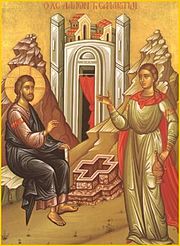
Orthodox icon of Photina, the Samaritan woman, meeting Jesus by the well.
The in-depth account about Jesus and the Samaritan Woman at the Well is highly pregnant for understanding Jesus in several relationships: Samaritans, women, and sinners. By talking openly with this adult female, Jesus crossed a number of barriers which normally would have separated a Jewish teacher from such a person every bit this adult female of Samaria. Jesus did iii things that were highly unconventional and astonishing for his cultural-religious situation:
- He as a man discussed theology openly with a woman.
- He as a Jew asked to drink from the ritually unclean bucket of a Samaritan.
- He did not avoid her, even though he knew her marital record of having had five former husbands and now living with a man who was not her hubby.
The disciples showed their astonishment upon their return to the well: "They were marveling that he was talking with a woman.[Jn. 4:27] A man in the Jewish world did non unremarkably talk with a woman in public, not even with his own married woman. For a rabbi to discuss theology with a woman was even more unconventional. Jesus did not defer to a woman merely because she was a adult female. He did not hesitate to ask of the woman that she let him drink from her vessel, just he also did not hesitate to offer her a drink of some other kind from a Jewish "bucket" as he said to her, "Salvation is of the Jews."[Jn. 4:22] Salvation was coming to the Samaritan adult female from the Jews, and culturally there was cracking enmity betwixt the Jews and the Samaritans (considered a one-half-breed race by the Jews).[17] Although she was a Samaritan, she needed to be able to beverage from a Jewish "vessel" (of conservancy) and Jesus no more sanctioned Samaritan prejudice confronting Jew than Jewish prejudice against Samaritan.
This is an event without precedent: that a woman, and what is more a "sinful woman," becomes a "disciple" of Christ. Indeed, once taught, she proclaims Christ to the inhabitants of Samaria so that they besides receive him with organized religion. This is an unprecedented result, if ane remembers the usual way women were treated by those who were teachers in State of israel; whereas in Jesus of Nazareth'south way of acting such an effect becomes normal.
The key to Jesus' opinion is institute in his perceiving persons as persons. He saw the stranger at the well as someone who showtime and foremost was a person—not primarily a Samaritan, a woman, or a sinner. This evangelized woman became an evangelist. She introduced her community to "a man" whom they came to acclamation as "the Savior of the world."[Jn. 4:42] Jesus liberated this woman and awakened her to a new life in which not only did she receive but also gave. The Bible says she brought "many Samaritans" to organized religion in Christ.[v.39] If the men in John 1 were the first "soul winners," this adult female was the first "evangelist" in John's gospel.[1]
The woman from Syrophoenicia [edit]
- Matthew xv:21-28, Mark 7:24-30
This incident is unlike any other in the canonical Gospels. The adult female, whose little daughter was possessed by an impure spirit, came and fell at his feet. The adult female was a Greek, born in Syrian Phoenicia. She begged Jesus to drive the demon out of her girl. Jesus seems harsh toward the woman as he first denies her asking for assist for her girl. He also appears to exist condescending and denigrating of her every bit he says, "First allow the children be fed, for information technology is non fitting to take the bread of the children and throw it to the dogs."[Mk. seven:27] In the context, "the children" seem to exist Jews and "the dogs" Gentiles.
She is identified as "a Greek, a Syrophoenician past race."[Mk. 7:25] The point is not that she is a adult female, just that she is not Jewish, but a Gentile. "Dogs" was epithet of the mean solar day for Gentiles, and Jesus appears to exist on the side of Jewish contempt for Gentiles. In both Mark and Matthew, not-Jews are likened to "dogs," and a woman deeply concerned for her girl'due south condition is brushed off until she herself prevails in her discourse with Jesus.
As to the manner of Jesus with women, he did not substitute uncritical deference for prejudice against women. He related to women as persons with words and dignity. In this story as elsewhere, Jesus is seen equally capable of manifesting a critical stance toward woman, yet at the same time being respectful of her cocky-affirmation as she boldly countered his own remarks.[i] : p.115
Why Jesus appeared harsh to a disadvantaged person, and also seems to lose the brief spirited and incisive dialog with her is notwithstanding debated among authorities. Several interpretations have been offered past theologians.
Evelyn and Frank Stagg suggest three possibilities:
- Jesus could have been instructing his disciples, get-go assuming a familiar Jewish prejudice toward not-Jews, and then abandoning it as its unfairness was exposed. The story may take served as an object lesson nigh prejudice to his disciples as a bulwark is broken down betwixt Jews and Gentiles.
- Jesus may take been testing the adult female's religion. Jesus' departing word to her is one of affirmation and acclaim. She passed his examination.
- There may take been a deep struggle within Jesus every bit he dealt with the claims of both Jew and Gentile. He had openness to Jews who were outside of accepted circles (publicans, sinners, prostitutes). He likewise went out of his way to affirm Samaritans (for example, the woman at the well). Every bit an ethnic group, Samaritans had mutual antagonism with the Jews. It is articulate that Jesus had to give himself unreservedly to State of israel, and nevertheless also to the rest of the earth. Jesus may have been having a deep, honest struggle within himself over the claims of two worlds upon him.[1] : pp.113–115
Gilbert Bilezekian believes Jesus' seemingly indifferent attitude to the woman's plea and the strange dialogue that followed should not be interpreted equally reluctance on his function to minister either to Gentiles or to a woman. He focuses on her faith, which Jesus after describes as "great".[Matt. 15:28] Wanting her to land her agreement of his ministry building, he drew out her convictions and provided an opportunity to teach a lesson of racial inclusiveness to his "intolerant disciples". She expressed her faith that Gentiles have a share in salvation, confessing that his messiahship transcends human segregations of Jew, Gentile, man or adult female. She was his first catechumen in the "Gentile world".[ii] : pp.100–101
Mary and Martha [edit]

Luke and John testify that Jesus had a shut relationship with the sisters Mary and Martha who resided in Bethany.[1] They are featured in three major stories:
- A tension between the two sisters over roles[Lk. x:38–42)]
- Grief at the expiry of their brother Lazarus, followed past his being raised,[Jn. 11:1–44] and
- Martha serving and Mary anointing Jesus (explicitly in John 12:one–viii); presumably in Marking 14:3–9; Matthew 26:6–13). See the anointing in Bethany.
Kitchen and study [edit]
- Luke 10:38-42
Luke relates an occasion of tension during i of Jesus' visits to the domicile of Martha and Mary. While Martha prepared the meal, Mary sabbatum at the feet of Jesus and "she was hearing his give-and-take."[Lk. 10:39] Martha became distracted and frustrated over having to serve the meal without any aid from her sis. Finally she openly shared her feelings, stood over Jesus who was either seated or reclining, and complained: "She came to him and asked, "Lord, don't you care that my sister has left me to exercise the piece of work by myself? Tell her to help me!" Jesus gently rebuked Martha for being then distracted and troubled over many things, when only one affair was necessary. "Martha, Martha," the Lord answered, "yous are worried and upset about many things, just only i affair is needed. Mary has chosen what is ameliorate, and it will non be taken away from her."[Lk. x:41-42]
Mary's choice was not a conventional one for Jewish women. She sat at the feet of Jesus and was listening to his teaching and religious instruction. Jewish women were non permitted to touch the Scriptures; they were non taught the Torah, although they were instructed in accordance with information technology for the proper regulation of their lives. A rabbi did not instruct a woman in the Torah. Mary cull the "skilful part," but Jesus related information technology to her in a teacher-discipleship relationship. He admitted her into "the study" and commended her for her selection. In the tradition of that day, women were excluded from the chantry-oriented priestly ministry, and the exclusion encroached upon the Give-and-take-oriented ministry for women. Jesus reopened the Word-ministry for women. Mary was at least one of his students in theology.
Jesus vindicated Mary's rights to exist her ain person—to be Mary and not Martha. He showed his approval of a woman'due south correct to opt for the written report and not be compelled to be in the kitchen. Jesus established his own priorities in declaring, "Man shall not live by bread lonely, simply past every give-and-take proceeding out through the oral fissure of God.[Mt. iv:4] Martha needed to be reminded of the priority of Word over bread. Luke's business relationship of Jesus at the home of Mary and Martha puts Jesus solidly on the side of the recognition of the full personhood of woman, with the right to options for her own life. By socializing with both sisters and in defending Mary's right to a role then commonly denied to Jewish women, Jesus was following his far-reaching principle of human liberation.[1]
The grieving sisters [edit]
- John eleven:i-44
One of Jesus' virtually famous miracles was raising Lazarus from four days in the tomb. But information technology is likewise a hitting reminder that while God works all things for the best, He doesn't always do it according to the schedules we expect.[19]
Jesus' followers had given upward hope after Lazarus' expiry, but Jesus had a plan to glorify God and heal Lazarus in a more spectacular mode than anyone expected. The primal effigy, however, is Jesus, identified as "the resurrection and the life." When the brother of Mary and Martha became ill, they sent for Jesus. For some undisclosed reason, Jesus did not arrive until 4 days later Lazarus died. The grieving sisters, Martha first and then Mary, met Jesus. Jesus raised Lazarus from the dead and then proclaimed himself every bit "the resurrection and the life." Martha gently reproached Jesus, "Lord, had y'all been here, my brother would not accept died." She hastened to limited full confidence that God would grant whatever Jesus asked him to grant. Martha reflected a spiritual agreement beyond that required for preparing and serving a meal.[Jn. xi:21–27]
Apparently, Martha and not just Mary had benefited from the study. Mary stayed in the house until Jesus called for her. When Martha went to go her, Mary came speedily roughshod at Jesus' anxiety (Mary is at the feet of Jesus in every advent recorded in John'due south gospel). She repeated the words Martha already had used: "Lord, had you been here my brother would not take died." Jesus was deeply moved upon seeing Mary and her friends weeping. They invited Jesus to come and see the tomb where Lazarus had been laid. Jesus burst into tears. The Jews standing by understood this as reflecting Jesus'southward love for Lazarus, "see how he loved him" (v. 36). The foursome of Jesus, Mary, Lazarus, and Martha had a shut human relationship as persons, with neither denial of gender differences nor preoccupation with it. Hither were persons of both genders whose mutual respect, friendship and love carried them through experiences of tension, grief, and joy. Patently Jesus was secure plenty to develop such a relationship with two sisters and their brother without fear for his reputation. When necessary, he could oppose them without fear of chauvinism. Jesus had much to practice with the liberation and growth of Martha and Mary.[one]
In the account of the raising of Lazarus, Jesus meets with the sisters in plough: Martha followed by Mary. Martha goes immediately to run into Jesus as he arrives, while Mary waits until she is called. Every bit ane commentator notes, "Martha, the more aggressive sister, went to run into Jesus, while serenity and wistful Mary stayed dwelling house. This portrayal of the sisters agrees with that plant in Luke 10:38-42."[20] When Mary meets Jesus, she falls at his feet. In speaking with Jesus, both sisters lament that he did non arrive in time to foreclose their blood brother's death: "Lord, if you had been hither, my blood brother would non take died."[Jn. eleven:21,32] Merely where Jesus' response to Martha is one of teaching calling her to hope and faith, his response to Mary is more emotional: "When Jesus saw her weeping, and the Jews who had come along with her too weeping, he was securely moved in spirit and troubled.[Jn. xi:33] As the 17th-century British commentator Matthew Henry notes, "Mary added no more, every bit Martha did; but it appears, past what follows, that what she fell brusque in words she made upwardly in tears; she said less than Martha, simply wept more than."[21]
Women who all-powerful Jesus [edit]
The Gospels present two stories of Jesus being all-powerful by a woman: (ane) iii accounts of his being all-powerful in Bethany, only John's account identifying Mary with the anointing; and (2) 1 account of Jesus beingness all-powerful past a sinful woman who definitely was neither Mary (of Mary and Martha) nor Mary Magdalene.[22]
The Eastern Orthodox Church views Mary Magdalene, Mary of Bethany, and the "sinful adult female" as three different individuals, and as well maintains that Jesus was anointed on two unlike occasions: in one case by Mary of Bethany and one time by the "sinful adult female."
The anointing in Bethany [edit]
- Matthew 26:6-13, Mark 14:3-9, John 12:1-8
Jesus is quoted in Matthew as assuring that the story of a woman'southward sacrificial love and devotion to him will have a identify in the gospel wherever preached. Mary probably predictable Jesus' death, but that is non certain. At least her beautiful deed gave Jesus needed support as he approached his awaited hour. Each of the two sisters Mary and Martha had their own manner of ministering to Jesus: Martha, mayhap being more than applied, served him a meal; Mary lavishly anointed him.
A narrative in which Mary of Bethany plays a central part (in at least one of the accounts) is the event reported by the Synoptic Gospels and the Gospel of John in which a woman pours the entire contents of an alabastron of very expensive perfume over the head of Jesus. Just in the John account is the woman identified as Mary, with the earlier reference in Jn. 11:one-2 establishing her as the sis of Martha and Lazarus. The woman's name in not given in the Gospels of Matthew[26:six-thirteen] and Mark.[14:3-nine] According to Mark's business relationship, the perfume was the purest of spikenard. Some of the onlookers are angered because this expensive perfume could accept been sold for a yr'due south wages, which Marker enumerates as 300 denarii, and the money given to the poor.
The Gospel of Matthew states that the "disciples were indignant" and John's gospel states that it was Judas who was most offended (which is explained past the narrator equally being considering Judas was a thief and desired the money for himself). In the accounts, Jesus justifies Mary'southward activeness by stating that they would always accept the poor amidst them and would be able to assistance them whenever they desired, but that he would not ever be with them. He says that her anointing was done to prepare him for his burial. "Mary seems to accept been the merely one who was sensitive to the impending expiry of Jesus and who was willing to give a material expression of her esteem for him. Jesus' reply shows his appreciation of her act of devotion."[twenty]
Easton (1897) noted that it would announced from the circumstances that the family of Lazarus possessed a family vault[Jn. eleven:38] and that a large number of Jews from Jerusalem came to console them on the expiry of Lazarus,[11:19] that this family at Bethany belonged to the wealthier form of the people. This may assistance explain how Mary of Bethany could beget to possess quantities of expensive perfume.[23]
The anointing past a repentant sinner [edit]
- Luke vii:36-50
In the Gospel of Luke, Jesus is an invited guest in the abode of Simon the Pharisee. All at the tabular array were men. During the repast a woman known as "a sinner" entered the room and anointed Jesus' feet with her tears and with some ointment. Her tears fell upon his feet and she wiped them with her pilus.
The Bible does non say whether she had encountered Jesus in person prior to this. Neither does the Bible disembalm the nature of her sin. Women of the time had few options to back up themselves financially; thus, her sin may have been prostitution. Had she been an adulteress, she would take been stoned.
When Jesus permitted her to express her love and appreciation to him as she did, the host rejected it contemptuously. At a minimum, this story shows the manner of Jesus with 1 sinful adult female. His unconditional love for both saints and sinners may take been so well known that this woman had the courage to take this not bad risk to publicly express her love for him for seeing her not every bit a sex object to exist exploited, but as a person of worth.
Women who ministered with Jesus [edit]
- Luke eight:1–3
Luke'southward gospel is unique in documenting that there were many women who benefited personally from Jesus' ministry, but who also ministered to him and with him—even to the signal of accompanying him and the Twelve on evangelistic journeys. Virtually prominent amongst these is Mary Magdalene.[1]
Luke 8:one–three in the Greek text is ane long sentence. Its three principal focal points are Jesus, the Twelve, and certain women. Jesus is traveling through cities and towns, preaching the Kingdom of God, evangelizing, and accompanied by the Twelve. Other than mentioning that the Twelve were with him, nothing more is said of them here.
The primary motive of the paragraph seems to exist to bring into focus sure women, of whom there were "many". This passage presents them as recipients of healing at different levels of need, and also equally actively participating with Jesus and the Twelve, accompanying them in their travels. Luke makes special reference to the financial support of these women to Jesus' ministry building. He says at that place were many women. He points out that these included women who were prominent in the public life of the state as well equally in the church.
-
- Luke's business relationship specifies 2 categories of healing: evil spirits and infirmities. Jesus liberated and humanized people who otherwise were being enslaved or destroyed by forces inside themselves and in society. Jesus healed many women of "evil spirits and infirmities". Only of Mary Magdalene does Luke provide any particular of her healing, stating that "seven demons" had been cast out. Presumably these "many" women had been healed of various illnesses—concrete, emotional, and mental. No specific data is provided on Mary Magdalene's "7 demons". It is significant that women whose atmospheric condition subjected them to contemptuousness and penalisation institute in Jesus a Liberator who not simply enabled them to discover wellness, merely who dignified them every bit full persons by accepting their own ministries to himself and to the Twelve.[ane]
Thus, information technology is significant that women had such an open and prominent role in the ministry of Jesus. Luke's word for their "ministering" is widely used in the New Testament. Its noun cognate, diakonos, is variously translated "minister," "servant," and "deacon" (the latter for Phoebe in Romans 16:1 and in the pastoral letters).
In summary, Jesus attracted to his movement a large number of women, ranging from some in drastic need to some in official circles of government.[1]
Jesus on family relationships [edit]
Jesus ate with a Pharisee leader i evening. After instructing his host to include the most disadvantaged in his feasts, Jesus gave a parable of the many personal reasons why guests might decline an invitation, including marriage and recent financial acquisitions.[Lk. xiv:18–20] Jesus then addresses a great multitude and says, "If anyone comes to me and does not hate father and mother, wife and children, brothers and sisters—yes, even life itself—such a person cannot be my disciple."[Lk. 14:26]
Various expositors suggest that "hate" is an example of comparative hyperbolic biblical language, prominent in some Eastern cultures even today, to imply "beloved less than you give me," "compared to Christ,"[24] the Semitic thought of "lower preference," a phone call to count the cost of following Jesus.[25]
When Jesus was told that his mother and brothers waited for him exterior and wanted to speak to him, Jesus created a novel definition of family unit. He said to the people who were gathered to hear him speak, "Who is my mother? and who are my brethren? And he stretched along his hand toward his disciples, and said, 'Behold my mother and my brethren! For whosoever shall do the will of my Father which is in heaven, the same is my blood brother, and sister, and female parent.'"[Mt. 12:48–50]
Twelve and no women (and no Gentiles) [edit]
There were no women amid the Twelve, and neither were at that place whatsoever Gentiles. All iv listings in the New Testament of the names of the Twelve point that all of the Twelve were Jewish males:
- Matthew ten:i–iv
- Marker 3:thirteen–xix
- Luke vi:12–16
- Acts 1:13
The names vary in the iv lists, but their male identity is clear and is often cited as biblical testify that pastors should all be male. The New Attestation gives no clear reply why the case of Jesus in choosing his apostles is non a complete overcoming of male person bias.[1]
Several considerations may be placed alongside this one. Jesus avant-garde diverse principles that went across their immediate implementation. For instance, he conspicuously repudiated the Jew-Samaritan contempt, affirming non only his own Jewish kin but also the Samaritan. Even so, there are no Samaritans among the Twelve. Jesus affirmed both women and Samaritans as persons having the fullest correct to identity, liberty, and responsibility, merely for some undisclosed reason he included neither women nor Gentiles in his shut circle of the Twelve.[ane]
Perhaps custom here was so entrenched that Jesus but stopped short of fully implementing a principle that he made explicit and emphatic: "Whoever does the will of God is my blood brother, and sis, and mother."[Mk. 3:35]
By selecting 12 Jewish males, Jesus may have been offer a parallel to the 12 patriarchs or 12 tribes of Israel, each headed by a son of Jacob.[ane]
Some other possible caption surrounds the purpose stated for his choosing the Twelve: "...and then that they might be with him."[Mk. 3:fourteen] They were his constant companions 24-hour interval and nighttime—except when he sent them out to preach. Information technology was the custom for Jewish rabbis to have such an entourage of disciples. "Such close and sustained association with a member of the contrary sexual practice would have given rise to defamatory rumor."[3] : p.174
However the restriction of the Twelve to Jewish men is to be accounted for, Jesus did introduce far-reaching principles which bore fruit even in a former rabbi, the Campaigner Paul, who at least in vision could say, "There is non whatsoever Jew nor Greek, not whatsoever slave nor free, there is not male and female person; for you are all i in Christ Jesus."[Gal. 3:28] Further, the inclusion of "many" women in the traveling company of Jesus represents a decisive move in the germination of a new community. The Twelve are all men and besides are all Jews, simply even at this indicate women "government minister" to them.[one]
The Staggs' believe a likely explanation to exist that Jesus began where he was, within the structures of Judaism every bit he knew it in his upbringing. His closest companions initially may have been Jews, men, and men of about his own age. He began there, merely he did non terminate there. Even in the early stages of his mission, women were becoming deeply involved at the ability centre of Jesus' movement.[1]
Fulton Sheen wrote extensively on this field of study and believed that Jesus preached to the Jews beginning because they were the people promised the Messiah. In the same mode that they received the Good News first, before information technology was preached to the residue of the Gentile world, so as well Jesus's 12 Apostles were all Jews. This did not bar Gentiles from being accepted into the Church, nor from existence ordained. Yet, it is of import to note that the choosing of women apostles would not have interfered with the preferential treatment of Jews in Jesus's mission, and the Church understands His choice to exclude women from the priesthood He founded to be divinely inspired and set up for all time.[26]
See likewise [edit]
- Female disciples of Jesus
- Christian feminism
- Myrrhbearers
Notes [edit]
- ^ a b c d due east f g h i j k l m n o p q r s t u Stagg, Evelyn and Frank. Woman in the World of Jesus. Westminster John Knox Pr, 1978. ISBN 978-0-664-24195-7
- ^ a b c d e f g Bilezikian, Gilbert. Across Sex Roles. Bakery, 1989. ISBN 0-8010-0885-ix
- ^ a b Starr, Lee Anna. The Bible Status of Adult female. Zarephath, N.J.: Pillar of Burn down, 1955.
- ^ a b c King, Karen I. "Women in Ancient Christianity: the New Discoveries." Public Dissemination Organization (PBS) Frontline: From Jesus to Christ—The Commencement Christians. Online: https://www.pbs.org/wgbh/pages/frontline/shows/religion/get-go/women.html. Accessed 01–eleven–2008.
- ^ Blevins, Carolyn DeArmond, Women in Christian History: A Bibliography. Macon, Georgia: Mercer Academy Press, 1995. ISBN 0-86554-493-X
- ^ King, Karen L. "Women in Aboriginal Christianity: The New Discoveries." https://www.pbs.org/wgbh/pages/frontline/shows/faith/beginning/women.html
- ^ a b Bailey, Kenneth E. "Women in the New Testament: A Center Eastern Cultural View," Theology Matters, Jan/February 2000
- ^ a b Fontaine, Carole R. (1996), "Disabilities and Illness in the Bible: A Feminist Perspective", written at Sheffield, U.K., in Athalya Brenner, A Feminist Companion to The Hebrew Bible in the New Testament (1st ed.), Sheffield Bookish Press
- ^ cf. Leviticus 23:3
- ^ Ben Witherington, Women in the Ministry of Jesus: A report of Jesus' attitudes to women and their roles as reflected in his earthly life, Cambridge University Press, 1987, ISBN 0-521-34781-5, p. 39–41.
- ^ Joel B. Greenish, The Gospel of Luke, Eerdmans, 1997, ISBN 0-8028-2315-7, p. 527.
- ^ Matthew Henry's Curtailed Commentary http://www.christnotes.org/commentary.php?com=mhc&b=43&c=2
- ^ William Temple, Readings in St John'due south Gospel. London: MacMillan, 1961. p. 35,36
- ^ Witherington, Ben III. "Mary, Mary, Boggling," http://www.beliefnet.com/story/135/story_13503_1.html Archived 2008-09-17 at the Wayback Machine
- ^ The earliest Greek manuscripts, the earliest translations and the primeval church fathers all lack reference to this story. Near of Christendom, all the same, has received this story equally authoritative, and modernistic scholarship, although terminal firmly that information technology was not a function of John's Gospel originally, has generally recognized that this story describes an event from the life of Christ. Furthermore, it is as well written and as theologically profound every bit anything else in the Gospels.
- ^ "Jesus Forgives a Woman Taken in Adultery." InterVarsity Press New Testament Commentaries. October. two, 2009: <http://www.biblegateway.com/resources/commentaries/IVP-NT/John/Jesus-Forgives-Woman-Taken>
- ^ Deffinbaugh, Bob. "The Good Samaritan (Luke ten:25-37)." Bible.org. <https://bible.org/seriespage/good-samaritan-luke-1025-37>
- ^ John Paul II. The Dignity and Genius of Women. Love & Responsibility Foundation, Common cold Spring, NY October 2003. Web: 17 Jan 2010 John Paul Two Archived 2010-02-15 at the Wayback Machine
- ^ "Lazarus." Gospel.com. Oct. 2, 2009. <http://www.gospel.com/topics/lazarus>
- ^ a b Tenney, Merrill C. Kenneth 50. Barker & John Kohlenberger III (ed.). Zondervan NIV Bible Commentary. Grand Rapids, MI: Zondervan Publishing House.
- ^ Henry, Matthew (1706). Complete Commentary on the Whole Bible.
- ^ Discussed in Van Til, Kent A. Three Anointings and One offering: The Sinful Adult female in Luke 7.36-50 Archived 2012-07-07 at annal.today, Periodical of Pentecostal Theology, Volume xv, Number ane, 2006, pp. 73-82(10). However, the author of this commodity does not himself hold to this view.
- ^ "Mary", Easton'southward Bible Dictionary, 1897.
- ^ John Wesley http://www.christnotes.org/commentary.php?com=wes&b=42&c=fourteen
- ^ John Darby http://www.christnotes.org/commentary.php?com=drby&b=42&c=14
- ^ writer., Sheen, Fulton J. (Fulton John), 1895-1979 (September 2020). Life of Christ. ISBN978-93-89716-30-6. OCLC 1256385096.
Source: https://en.wikipedia.org/wiki/Jesus%27_interactions_with_women
0 Response to "Free Timothys Vision of Jesus Standing to Welcome Him Home Clip Art"
Post a Comment